For years, I’ve been on the Site Build It list. SBI is the creation of the rather annoyingly gushy Ken Evoy who never stops his carnival barker cries about his one-stop-site-creation tool.

Ken Evoy Pumping Site Sell

Evoy’s been at it since the bad old days when the internet was a mess and Site Built It! did have the advantage of actually getting a website up in some form – easier than coding html from scratch for the neophyte.
Throughout SBI’s history, Evoy has shrieked about his process and his proprietary tools. On the surface, a clear process and proprietary tools are a good idea. Probably worth the price of admission (or so I thought at the time). The issue with the proprietary tools (which otherwise might be a good deal) is that you can only use them a little bit. Come and play for one hour per week, see you next week. Not exactly inviting brainstorming or creativity.
In contrast, the indepdendent expensive (many of which are free) tools Evoy condemns let you use them as much as you like once you find them.
Over the years, I’ve learned not to expect much from Evoy’s newsletters (sometimes for six months at a time, they get relegated to the read later bin). Still it’s worth sometimes checking in on somebody who’s multiyear obsession has been selling ecommerce sites. Another perspective.
In the last couple of years the internet has changed and it’s actually quite easy to put a website up. Just buy a hosting account (a single domain account is $3 to $7 Ken, not the $10 to $15 you cite), click the one step install button and you have vanilla WordPress (or Mambo or Joomla or whatever else catches your fancy). Or pay nothing and sign up at WordPress.com and have a better than vanilla WordPress install with lots of attractive themes ready and waiting for you and an active forum.
The ease of putting up a high quality website – almost all of which look better than Site Build It websites and are easier to post to – is naturally a huge threat to the SBI business. Why pay Ken Evoy $300 per year per website for hosting which should cost $50?
Evoy’s latest missive starts yet another hysterical title “Why blogging is a massive mistake!” Exclamation mark is his.
Writing a weblog is not a massive mistake. Handled properly, a weblog does wonders for your website traffic and search engine standing. But taking away the hype, this time Evoy does have a worthwhile point about weblog type sites (WordPress in particular) – i.e. they date like stale newspaper. I can confirm the tendency from my own sites.
By publishing a weblog, you are effectively creating just a daily news source.
What happens if you publish a very good article which has value as a permanent reference? It stands alone in your weblog. People come, read the single article and leave. There may be other interesting content on your weblog for them to read but the visitor can’t be bothered to ferrret it out. If your writing or content is extremely compelling, perhaps some visitors will read a certain amount of your content. But then they will leave. Which quite frankly for an online journal is fine. You’re not selling anything.
But for a business, this isn’t so good. What you want is to create an information resource for people in your business, which will bring them back again and again. An information structure which invites them to find immediately the other relevant areas of interest.
And Evoy quite correctly points out that this is the built-in model for Site Build It:
Blog posts are created and stored in chronological order. A good blogger will produce a post that is useful today, but who will read it in three months? Even when bloggers go to the extra effort of archiving their posts by “keyword categories,” the articles are dated and not rewritten into coherent definitive articles. Usefulness plummets with time.
How does a Theme-Based Content Site differ? Instead of a stack of old newspapers, each resembles a good resource book about its theme, composed of useful, original articles (“Web pages”) that cover related topics in some depth. Written in each small-business owners’s unique voice, and based upon that person’s experience in the field, they are useful resources that visitors return to over and over.
Evoy correctly points out that a photography weblog would just be one in a million, posting the nattering about the latest cameras and software:
How would a blog be presented? A stream of disjointed photography tips would be organized by “date of post.” And posts on any given topic (ex., “portrait lighting”) would be separated by time (weeks or months apart), each covering only a certain aspect of the topic. On the other hand…
Definitely not the right one to pull someone into your website. Evoy contrasts the above weblog site with this siloed sitemap for a static site:

site build it silo site
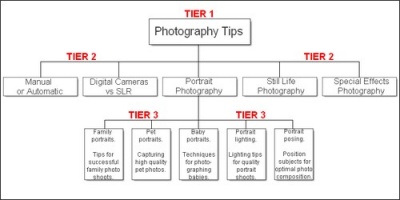
This time Evoy’s absolutely right. Someone looking for information on photography lighting would gradually be led through the whole of your website, would bookmark it and come back as a reference. All of this assumes of course that your content is top-notch (and Ken, let’s be frank, there’s not too many people capable of creating top-notch content, on or off the SBI rolls). But with a static site structure at least you stand a fighting chance of retaining your visitor and becoming a reference.
In any case this is a huge insight. Pages instead of posts something I’ve been playing around with in the static pages section in Foliovision. Our client sites are also largely hierarchical with the weblog performing weblog functions (added value).
What I’ve been doing is making a static page instead of a post and then publishing a small announcement on the weblog section.
Unfortunately some of the news outlets which republish my content will not link to static pages or to articles which are more than 24 hours old (a pain in the neck, as after publishing a major article I like to come back to it 12 hours later to proof it and add or correct illustrations).
Going forward, I am going to build up the static pages sections very actively. When I first publish a post, it will go into the weblog, but within a few days. There is one small issue which is comments. We enable comments on pages so visitors will still be able to comment on the static page. But often some of the comments come in right away (on the weblog version).
- Do I leave the comments on the weblog post or move them to the static page?
- If I choose to move the comments to the static page, there is no mechanism to do so inside WordPress. We’d have to build a plugin.
BTW, this sort of question is what you are paying Evoy to solve for you with either no solution (in this case) or his solution. For an inside the box thinker (or someone with very little design sensibility and/or minimal interest in technology), SBI solves a lot of problems. For an existing six-figure business, there are better ways to bring your business online than SBI DIYism. I do agree with Ken that business owners should have better things to do with their time than spend it troubleshooting websites or optimising their sites for Google.
If you’re interested in having a closer look at the Site Build It system and way of thinking, Ken Evoy offers a number of free ebooks on writing for the web, selling services and montization. SBI’s claim ithat the free ebooks are better than a lot of the pay ebooks out on internet marketing is more or less true. Given the rubbish sold as ebooks that’s not necessarily saying a whole lot. The link above bundles several of them into a single zip file for your convenience.
Personally, Ken’s writing style drives me up the wall (he’s been described as rah-rah), but the bulk of the information is good. I just can’t read past his marketing speech. The formatting is bizarre as well. I wish the guy would hire a graphic designer at some point. Why does he write Sidebar and then not make the sidebar a sidebar but whack it right into the middle of the text?
Some other references

Alec Kinnear
Alec has been helping businesses succeed online since 2000. Alec is an SEM expert with a background in advertising, as a former Head of Television for Grey Moscow and Senior Television Producer for Bates, Saatchi and Saatchi Russia.


You could just silo using blog posts.
Create a static page There is a siloing plugin I have written about before that just pulls in posts from a category on a static page, or you can just use some PHP Alternatively use “in series” to define a browsing path with real “sidebar” or call-ous.
Well, you could even just edit a page by hand
I went one stage further a while ago and describe how you can 301 old URLs to a single landing page, and then change the page slog on existing posts before adding them to a silo. A good option for a series of posts that pick up some links on a core topic, but not enough to really stand out in the SERPs.
Also of note, some tools do have usage limits, so for example you use credits with Nichebot.
There are tons of free tools out there, which is why people still write blog posts with junk titles and content and complain about traffic.
If you are aiming to only spend 4hrs a week on your website, limiting keyword research to 1hr isn’t a bad bet. I haven’t owned SBI so I am not sure how limiting this is before you start.
Hello Andy,
I agree that one can get a certain distance down the track with tools like a related posts plugin and/or a good setup of categories.
Search helps as well.
But it still doesn’t turn a weblog into a reference site.
On the other hand, a lot of experts (especially in the marketing area but not only) release high quality information relatively freely on their weblogs – and then resell that information properly packaged as a book. If they made the website into a real reference, they’d have a harder time selling the packaged product, especially if it’s one of those $277-$777-$977-$1977 snow jobs.
Which brings up a point, I didn’t make in the article above: at least Ken Evoy hasn’t raised his prices substantially over the years. He does charge for additional modules but given his guru type following, he does treat his clientele quite fairly. That’s a big plus in his favour. The other advantage to Site Sell is that Evoy reads the reams of internet marketing material spewed out on the internet for you. That’s a huge timesaver as you point out for somebody spending 4 hours/week on their website as a second business.
Anyway, I do think Ken’s main point retains a measure of validity, no matter how we gussy our weblogs up. Weblogs are the equivalent of newspapers (or if better written in, magazines). They date and do not become a lasting reference.
Many of us need to spend more time on the static part of our websites.
The key to success in internet marketing lies in content. It is said content is king, so is true, without providing good content you cannot convert visitors to customers. Without your site you provide little value for potential customers and minimize your SEO marketing.
Even if you come on the top of ranking charts but if content is not strong it will result in divergence of your traffic result in a big loss.
Always build content-rich websites that drive traffic and maximize conversion to increase your business.
Track what your visitors are actually looking for and evaluate your services or products accordingly. Go in for easy navigation and simple site structure. Good internet marketing is also necessary for getting traffic. Offer free newsletter related to your industry. Quick and speedy response is always liked by visitors. Provide a multiple option to contact e.g. email, phone number, live chat. Include rss feeds on your site.
Hello Concord,
What you’ve written has some truth: integrity is essential to all long-term marketing efforts.
I agree that we don’t need SBI to create sites like this. Although for the absolute technophobe who’d like to create a single business website, SBI is a solid enough alternative.
Wow! Finally some good advice instead of an affiliate hawking the product.
Based on your article I think WordPress solves all of Envoy’s issues (except traffic). For example you can have static pages and posts with WP2.5. You also can categorize posts and put tags on them.
The problem is traffic. Does SBI really get the great traffic results Ken touts? That would be worth the price of admission.
I’ve gone to SBI’s site a dozen times. Can’t actually get the facts. Does he include an autoresponder? A shoppping cart? Merchant account? Opt-in pages, etc? If so that would save me money from all the scripts, software and third-party payment systems I use now. But I can’t find this information and the hype, well it hurts my head.
Perhaps you could expand your information to answer what Ken doesn’t or won’t.
Again thanks. For now your great review is keeping me with WordPress.
Russ
Hello Russ,
You are absolutely right about the technical capabilities of WordPress. WordPress can do everything Ken Evoy talks about.
In the end, SBI doesn’t get the traffic, you do. Ken’s focus on quality content via Content -> Traffic -> PREsell -> Monetize (C T P M) is what puts SBIers above your standard make money online – small business crowd.
If you don’t put out really high quality content, your site is a dead man walking. Visitors won’t come back and sooner or later, Google will catch you.
A lot of the components you describe are include within SBI. The components that aren’t included are paid but integrated options. The system is really a lot simpler for those who are not technically inclined. You do get free tech support as well (up to certain limits). On the other hand, those who are technically inclined/gifted do chafe at the restrictions of SBI, as they don’t need or want blinkers on (i.e. there aren’t many elite webloggers running SBI).
You can try SBI for awhile and there is a money back guarantee. They do honour it. Let me know if you would like to give SBI a try Russ and I will get you a discount . I’ll even publish your impressions as an SBI new user.
I have been using SBI for a while now. I think that it’s a great start for someone who knows nothing about developing a website or internet marketing.
SBI in my opinion is very good in many ways. Their brainstorming tool for keyword research is great in its ability to rapidly highlight keyword traffic and competition and projected profitability. They have a very helpful user community.
However, their built in blog feature is very weak. It doesn’t provide for comments and is only nominally a blog.
The tiered site structure issue is a very important one that provides a lot of power and makes a site friendly for users. SBI develops this idea very well in terms of its navigation buttons and internal linking structure.
However, I think that this aspect could easily be emulated in a WordPress blog. All one would need to do is to create a static page and put sitemap like links in it. The navigation would come from this page and from internal cross reference links.
This effectively would convert WordPress into a vehicle for creating a tiered somewhat static site.
Of all the websites I have built, only the sites built and structured according to SBI rank well in the search engines. I used to build sites using James Martell’s methods: 5 or so main pages with hundreds of articles pointing to these main pages. The search engines never liked this structure and the result was no traffic. Go with SBI, it’s the best way to build a site for anyone.
Hello Kevin,
I don’t think it’s a matter of building according to SBI – the vast majority of high ranked sites on the Internet are not SBI.
The issues you were running into are:
As you not, SBI, for the most part, incorporates these as well as many other useful rules for building successful websites.
Thanks for stopping by.
The main benefit of SBI is that the site builder is forced to think about content. At least this is what SBI is doing for me. It is very hard work and there are frustrations, but as Ken Evoy often points out, at least I haven’t invested large quantities of time and money in building a beautiful site that has weak content and is thus doomed to failure. Yeah, I worry about how I’m going make a site that looks the way I want it to using SBI’s blockbuilder. I do not like the L&F of most SBI sites. But I know that this concern is just a distraction from the more important issues of site theme and content. Really, preoccupation with site L&F is a bad habit that I need to break, or at least a habit to keep under wraps until my site has a solid theme and good content.
Hi Mike,
Your take is a good one. If working within the constraints of SBI, keeps you focused on content instead of tinkering with layout, it’s well worth the $300/year. Content is where it’s at!
Once you have a really successful site, you may want to take it out of the constraints of SBI though. I know Ken Evoy keeps talking about removing the visual straitjacket, I haven’t seen much evidence of it.
Our clients pay a lot of money to have us wrestle with these questions rather than them. Most of the time, we even come up with the content – they are too busy to fiddle with websites and we stive to keep them that way: by sending them even more business.
I am following diligently thru the SBI lessons, and appreciate the approach and high integrity focus on quality content. but I am totally underwhelmed by the look and feel selections. I am non technical, with no site building experience, but am now working on some membership and ebusiness sites full time, and don;t wantto waste my time or not be happy with my results. Can either Alec or another reader assist me creating a quality look and feel within SBI, or is it a lost cause? I like the look of several clean simple wordpress themes, but not the information structure and layout for all the resons discussed on this thread. Any assistance is much appreciated
Hello Nathaniel,
If you don’t like the look of SBI sites, it’s pretty stiff uphill sledding. I have yet to see a SBI site which impressed me visually. SBI is a good framework in which to start a site if you have a limited technical background. If I had a really successful site, I’d be unlikely to leave it in the relative creative and technical straitjacket which is SBI.
I’ve sent you a note.
I agree that content is king. However where most SBIers fail is that besides not reading the material that Ken Evoy offers, they don’t follow directions.
It’s not just content…it’s the right kind of content. The process involves researching your niche and knowing how to find the keywords…
It’s a hit-or-miss project in sitting down and finding a niche and then finding a profitable area with the proper keywords and then developing content and organizing your site according to SBI’s guidelines.
When a newbie first gets involved in network marketing, he probably has a couple ideas he’d like to pursue and hopefully make money. The problem is that he finds out later after shelling out the $299 for the SBI website and then doing the keyword research for supply and demand, he finds there isn’t enough demand to support his website.
Then he has to come up with alternate ideas for a website and then develop at least thirty pages of content. The content for his website now has to be better than the millions of other websites with the same idea.
I’m still not clear on how SBI helps with its SEO wizardry to vault someone to the top of Google. I haven’t seen it with mine.
Hello Dave,
Your point is quite valid.
Where SBI helps is that it’s one stop shopping on the low end.
Just sign up, follow the instructions and you have a kick at the can.
Otherwise internet marketing is just too overwhelming for most beginners.
Foliovision is a similar company except we work mainly at the extreme top end, building hugely successful websites for already successful businesses. We do content, SEO, spam filtering, the works.
We just make the pain go away.
And make the phone ring.
Our clients are too busy with the rest of their business to want to take on all of these challenges. Why would they? They make far more money we do, their time is too valuable to want to spend it on the nuts and bolts of internet marketing.
My 150 +articles dolphin SBI site does get 500-1000 visitors daily even though I haven’t touched it for three years and it’s profitable. SBI does work! The only issue is that I have to write content, which I don’t find the time to.
I have bypassed the block mode and created it in HTML. This allowed me more creative freedom in my theme, but now the site is harder to upgrade, but this will be solved by using new SBI server-side includes (a bunch of migration is needed).
The C2 module seems very promising and this is the next step – to upgrade my SBI site into a controlled community / directory.
I just wanted to say that I find all the resources at SBI to be extremely helpful. They are in one place and I can focus on building my content. I have a lot of pages I still need to put up on my site… haven’t worked on it in a bit, but I really like how SBI has helped me formulate my site “blueprint” and set up goals to get done. Also, you will notice from my site- I do not have the standard SBI look. I wrote my own code. SBI now offers a 3 column template like this, apparently now, too, though I haven’t looked at it.
My other site is trenchquote.com That one does have many pages. I don’t know how great my look and feel is, but I do have control over it. Both are SBI!
I found this post because I was googling wordpress and SBI. I want to be able to organize (tag) some product reviews like you do in blogs, but I want the rest of my content on static pages. Not too sure what I am going to do about that yet.
Hi Alec,
Would you say that Silo Structured websites are becoming more and more important now with SEO?
We’ve noticed that it’s making a huge difference now with ranking in the SERPS.
HI Joshua,
How have you noticed silo structure making a difference. Do you have an A/B or before/after case study?
All our sites have been siloed for awhile. To be honest, I don’t think siloing is enough to withstand the latest Panda and Penguin updates on its own.
Hi Alec I found your article interesting, thx.
I started with my first site back in the mid 2000’s and at the time built the site with frontpage and was self taught. I managed to get the site up in the search results with a lot of hard work, and in the process I realised that the structure of ones content is very important.
I then decided that for a new business idea there must be some kind of software available that would take all of the SEO things in mind while helping one build a good site. It was at this point that I found SBI (around 2006) ….I also found all the marketing hype and stuff quite irritating but since they could show a lot of top performing sites, run by individuals and small business owners I decided to give it a try.
The result has been quite good from the point of view of being forced to concentrate very clearly on building a no tricks structure of content that is real. My ongoing frustration has been the visual aspect as you say that is often old looking and far from appealing. My traffic climbed steadily and weathered Panda but got hit badly by Penguin.
For the last 6 months there has been a huge song and dance about BB2, (block builder 2) which is SBI’s answer to try to solve some of the problems you mention. I waited and waited and eventually now it has been rolled out but for me (due to the high number of images on my site) it has proved to be a let down. For many with largely text and the odd image, it will be great, but for multiple images it seems to fall over.
I am at a loss as how to go forward and wondered what you advise? I get around 1600 visitors per day and the site is making money but needs a revamp. Also it is integrated with a FB page that has a lot of artists following.
SBI are saying I should upload my own CSS template and get going converting all the pages with BB2. To me if I have to do all that maybe it is an opportunity, to take a leap forward. What si currently the future of the web, with all the new mobile and tablet devices flooding the web. Is the old style website going to be dead, and will Apps on mobile devices take over?
These are questions I would like to see SBI tackling..
Regards Andrew
Hi Andrew,
Thanks for sharing the updated info about SBI with us.
I’d say get out while you are transitioning. The problem SBI people face is that you are used to a single modest annual fee for a broken donkey cart. Unfortunately proper development for real businesses is a larger investment.
The days of just post throw up a bit of content in a ho-hum way and wait for the visitors to pour in is over. Those days did exist and SBI did help many people then.
It’s kind of go big or go home time. Running a successful website now is like running a successful restaurant in a big city: the rewards are great but so is the competition.
Another crippling aspect of SBI is that all you guys ended up saddled with hyphenated domains (which was a foreseeable danger) when Google removed the bonus and added a penalty for multiple hypens in a domain. Very bad suggestion from Dr. Evoy.
All of that said, we’d be happy to help migrate people out of SBI properly at rates similar to our Typepad and Drupal migrations.
Hi Alec
In the meantime, I have managed to resolve some of the issues I face on SBI and they have agreed very kindly to help with some free coaching to help transition the changes.
What is the penalty Google gives for 2 hypens in a domain?
The real issue I face is not so much SBI’s fault as the fact that I have a lot of copy & paste content in my directory that Google is unfairly penalizing. (I would need to re-write 420 pages)
What kind of money are you saying someone starting would need to invest?
Regards Andrew
Hi Andrew,
I’m not sure Google would agree that copy and past content penalties are unfair. That kind of material has been a long term target.
That’s the point: copy and paste content and SBI level “tricks” won’t get you there anymore. Personally I think it too Google too long to get here.
Hi Alec
SBI has never endorsed Copy and Paste and neither do I. I am talking about a directory of artists, where people list their services. In this case they (often copy the description of what their company does and services offered from their own websites) into their automatic submission on my site. In this case where one is consolidating a lot of helpful information on one site (a list of all face painters globally), there should be some kind of allowance for this?
Plus surely other sites with directories are also being penalized SBI or not…
Regards Andrew
Alec,
How much ‘on-page’ weight do you think is carried in SEO right now?
Hi Andrew,
The SBI crowd lives in another world. Copy and paste is not copy and paste. Any fee higher than $50 is unreasonable. I guess you’ll have to live with what you have. In my opinion, the internet has moved on from SBI.
Google doesn’t announce their exact penalty structure but one could see a substantial drop in domains with two hyphens or more a year or more ago. Others have argued that hyphenated domains were not giving off other quality signals.
Hi Joshua,
I’d say on-page SEO is about 1/3 of the mix: that includes titles, headers, meta descriptions, well structured pages, clean code, relevant images properly named and labeled.
An easy third to get with a properly set up WordPress site, check out FV Simpler SEO.
Interesting read. I have a number of WordPress sites and one SBI! site but here’s my problem with WordPress – in one word, automatic updates and incompatible plugins which cause my WP sites to either crash or not work properly until I discover the problem, sometimes by accident. The plugins I’m referring to are well known ones, such as “WordPress SEO” by Yoast, or Adsense plugins that become decommissioned but you don’t find out for a while & lose money. Sometimes I have to uninstall a plugin, then reinstall it for the site to work again. It’s quite frustrating.
SBI! on the other hand, I have found to be a stable and reliable platform that is integrated well and never lets me down.
However, I’ll be interested in any useful comments which readers have, where the abovementioned WordPress problems have been avoided. Then I might reassess the WordPress vs SBI! question.
Hi Peter,
I agree with you about the WordPress need for speed, ridiculous upgrade pace. Our business clients are extremely tired of never ending updates and incompatibility issues. The software is free and it’s enterprise level. People were paying $20,000/domain to license software half as capable ten years ago.
But WordPress takes most of that money back in constant updates. For a long time I’ve wanted to start something called BusinessPress which would have annual updates for new functionality and database. Otherwise the only updates would be security updates.
I think this would go well as Kickstarter type crowdfunding but we don’t have a North American business presence to allow us to use that platform.
On top of that WordPress has just announced that if you publish any non-GPL code you are no longer eligible to speak at any Wordcamp. WordPress.org and Matt Mullenweg have lost their minds and turned into some kind of totalitarian police state out of 1984.
A fine demonstration of Plato’s principle that the acquisition of power makes most men go mad.
Hi Alec,
Yes, I do see A/B differences in silo vs. non silo sites where silo gets a bit of favor. But with so many ranking factors, it’s usually a wash when you count the other factors that are going on.
Basically, we treat it kind of like an insurance for building our sites.
And, they help with user experience.
I live in Norway; in 2008, I discovered SBI and that I had to pay five to ten as much to get an equal product in Norway. SBI has all I need included except for web shop and things like that. Since then SBI have had a huge upgrade that makes me effectively create new pages. I have built several sites for myself and for customers, in every instance, all keywords are ranking on Google’s first result page, in every case they became internet market leaders in their field. Who did teach me the knowledge? Ken Evoy. What else should I expect of a website building concept? On importance of a blog; when search for solutions on the internet, Google has never directed me to blog content, only to usual website content. That tells me that Google mostly ignore blogs, and I do not want to waste my time.
I mention the doll-knitting-patterns site was one of the first ones in 2008, I mention it because it is partly in English, it was a kind of journeyman homework … today Alexa ranking 260 000, visitors from 160 countries … what Ken Evoy did teach me made me to one of the top internet marketing and SEO experts in Norway. You may say that that is about the Norwegian expertise level … or it is, as I experience it, about what SBI provides to their customers.